

Healing the Heart
Healing the heart begins with understanding what has hurt, quieting harsh self-talk, and learning to respond to yourself with greater compassion and truth. This guide explores emotional healing, shame, self-worth, and the gentle work of seeing yourself differently and moving toward greater wholeness.
You may not remember when you first started believing there was something wrong with you.
Maybe it came through criticism, rejection, embarrassment, painful relationships, things you regret, or years of comparing yourself to people who seemed prettier, smarter, more capable, or more successful.
Whatever the circumstances, somewhere along the way, painful experiences can stop feeling like things that happened to you and start becoming evidence you use against yourself.
She’s prettier than I am.
She’s smarter than I am.
Why can’t I get my life together?
Everyone else seems to know what they’re doing.
What is wrong with me?
After enough years, those conclusions can become so familiar that you stop questioning them.
You simply assume this is who you are.
But healing begins when you start separating what happened to you from what you concluded about yourself because of it.
I used to think healing meant being strong enough to move on. I thought if enough time passed, if I kept functioning, if I didn’t dwell on the past, eventually I would be fine.
But I wasn’t fine.
I could keep going and still dislike myself. I could look capable on the outside while carrying shame, regret, comparison, and self-doubt underneath.
Eventually I had to learn something very different:
Healing is telling the truth about what hurt without turning that hurt into a verdict about who you are.
What you’ll learn in this post
How painful experiences can shape the way you see yourself
Why shame sounds so convincing
How to separate what you feel from who you are
Why comparison so easily becomes evidence against your worth
How to respond to yourself with curiosity instead of criticism
Simple ways to steady yourself when emotions rise
How self-compassion begins changing your inner voice
Practical steps you can start using today
If you are wondering where to begin, you do not have to understand everything at once.
Start by becoming curious about the story you have been telling yourself about who you are.
Because some of what you have accepted as truth about yourself may actually be pain that was never questioned.
I realized “acting strong” was not going to heal me
There came a point when I realized I was doing many of the things I thought I was supposed to do — moving forward, functioning, appearing fine — and yet shame was still there underneath it all.
So I had to ask myself an uncomfortable question:
If my version of strength requires me to ignore what hurts, is that really strength — or have I simply learned how to survive?
That question became a turning point for me.
Healing began when I stopped demanding that I “get over it” and started getting curious about what had shaped the way I saw myself.
I began learning to name what was happening inside me, calm what was happening in my body, and practice a truer thought rather than automatically believing the harshest one.
Not once.
Over and over.
Because the goal was no longer to convince myself that nothing had happened.
It was to stop allowing what happened to decide what I was worth.

1. Shame turns pain into a verdict about who you are
Shame is more than embarrassment.
It does not simply say, “I did something I regret.”
It says, “There is something wrong with me.”
That distinction matters because shame takes an experience, a mistake, a rejection, a weakness, or a painful season and turns it into a conclusion about your worth.
Brené Brown describes shame as the painful belief that we are flawed and therefore unworthy of love and belonging.
That definition stopped me because it sounded so familiar.
Shame didn’t say to me, “Mary, you did something wrong.”
It said, “Mary, there’s something wrong with you.”
And once you begin believing that, it affects far more than how you feel.
You may hesitate to try something new because you assume you will fail.
You may stay quiet because you do not trust your own judgment.
You may tolerate poor treatment because some part of you believes you should be grateful anyone wants you at all.
You may look at another woman’s beauty, intelligence, confidence, education, or success and immediately use it as evidence against yourself.
That is what shame does so well.
It turns pain into proof.
My inner voice almost always took the side of criticism
For years, my inner voice was quick to turn an imperfect moment into a judgment about my whole self.
If I made a mistake, I did not think, “That was hard,” or “That did not go the way I hoped.”
I thought:
See? You’re so stupid.
You always mess things up.
Other people can handle life. Why can’t you?
And then comparison would take over.
I would look at other women and assume they were doing life better than I was.
Smarter. More attractive. More capable. More disciplined. More confident. More accomplished.
Their strengths did not simply belong to them.
In my mind, they became evidence against me.
That pattern kept me stuck because every comparison ended the same way: someone else had something I admired, and I used it to confirm what I already feared about myself.
But compassion slowly interrupted that cycle.
It taught me to pause before turning against myself.
To tell the truth without cruelty.
To let one mistake be one mistake.
To let another woman’s strength belong to her without making it proof of my inadequacy.
And to begin asking a different question:
What if this moment does not say anything final about who I am?

2. Name what you feel without making it who you are
Once I began noticing how quickly I turned painful feelings into judgments about myself, I started practicing one simple skill:
separating what I felt from who I was.
Instead of:
“I’m a mess.”
“I’ll never get this. I’m so stupid.”
“Everyone else is doing better than I am.”
“I’m hopeless.”
I began trying:
“I’m noticing shame right now.”
“I’m feeling anxious in my body.”
“I’m carrying grief today.”
“I’m feeling disappointed in myself.”
That shift may sound small, but it matters.
When you can name what you are experiencing without turning it into a definition of who you are, you create a little space between the feeling and the verdict.
Instead of:
I am a failure
you begin to recognize:
I am feeling ashamed because something did not go the way I hoped.
Those are not the same thing.
There was a season when one small trigger could pull me straight back into difficult memories. Before I fully understood what was happening, my mind would begin collecting painful moments from my past and using them against me.
Later, I began practicing two simple sentences:
“I’m noticing shame.”
“Shame is something I’m experiencing. It is not who I am.”
That practice helped me stop treating every painful feeling as proof that something was wrong with me.
A counselor I worked with also helped me look more carefully at the parts of myself that reacted so strongly.
At one point, I was guided to picture my younger self almost as if I were watching her from a distance.
For the first time, I could see that she was not weak or defective.
She was trying to protect herself.
She had learned to brace, guard, and react because those responses had once helped her survive painful things.
That changed the way I saw her.
Instead of criticizing her, I began to understand her.
And slowly, something softened.
The last time I pictured that younger version of myself, she was no longer bracing.
I imagined leaving her at the beach, laughing in the warm sun and playing in the waves.
Just a little girl, finally free to be a little girl.
I like this section because it reinforces a central idea: what you experience is not automatically who you are.
For Section 3, I would simplify it more. The physiology is useful, but I would avoid making this section feel like a nervous-system lesson. Keep it practical and grounded.
3. Calm your body before you try to reason with yourself
Sometimes your thoughts are not the best place to begin.
When your body is tense, hyperalert, or overwhelmed, it can be difficult to think clearly or respond with compassion.
Stress responses are automatic. Your body is designed to react quickly when it senses danger.
That means if you notice your shoulders tightening, your jaw clenching, your heart racing, or your body wanting to shut down, it does not automatically mean you are overreacting or failing.
It may simply mean your system has learned to stay ready.
Before you try to talk yourself out of what you are feeling, try helping your body settle first.
A few simple practices:
Drop your shoulders.
Unclench your jaw.
Let your exhale be a little longer than your inhale.
Place a hand over your chest and breathe slowly for a minute.
Look around and name what you can see, hear, and feel in the room.
Remind yourself, “I am here. I am safe in this moment.”
These practices are not about pretending nothing is wrong.
They are about giving your body enough steadiness that you can respond rather than spiral.
That small pause can make it easier to ask:
What am I actually feeling right now?
And then:
What do I need instead of another attack on myself?

Why I stopped shaming my stress response
I used to judge myself for feeling overwhelmed. I thought it meant I lacked faith, strength, or maturity.
Eventually, I began to understand that my stress response was not a character flaw. It was information.
That changed the question I asked myself.
Instead of:
“What is wrong with me?”
I began asking:
“What is my body trying to protect me from right now?”
That question moved me from self-criticism to curiosity.
And curiosity gave me something shame never could: enough space to respond with wisdom instead of turning against myself.
For Section 4, I would definitely simplify the definitions. You do not need Harvard, Kristin Neff, and Google all defining the same thing. One good definition plus your lived experience is stronger.
4. Self-compassion changes the way you respond to yourself
If shame teaches you to attack yourself when you are hurting, self-compassion teaches you to respond differently.
Kristin Neff describes self-compassion as treating yourself with kindness and understanding when you are suffering, struggling, or feeling inadequate.
For me, that idea was almost revolutionary.
I had spent years believing that criticism would make me better.
If I was hard enough on myself, maybe I would finally become more disciplined, more capable, more acceptable.
But harshness did not make me stronger.
It made me afraid of myself.
Learning to speak to myself the way I spoke to hurting people
There was a time when I would think things about myself that I would never have said to another person.
Not because I was trying to be cruel.
I simply believed I deserved it.
I could offer compassion to someone else who was hurting, struggling, embarrassed, or ashamed.
But when it was me, I became the judge.
I replayed mistakes.
I exaggerated weaknesses.
I used disappointment as evidence that I was exactly as flawed as I feared.
Looking back, that breaks my heart.
Then I learned about self-compassion.
At first, the idea felt almost foreign.
But I began practicing a few simple questions:
This is hard.
I am not the only person who struggles.
What do I need right now?
Those questions did not excuse bad choices.
They did not pretend everything was fine.
They simply gave me another way to respond to myself.
And over time, that mattered.
Because healing did not begin when I finally became impressive enough to approve of myself.
It began when I stopped believing cruelty was the price of growth.
I especially like that last line for you:
“Healing did not begin when I finally became impressive enough to approve of myself. It began when I stopped believing cruelty was the price of growth.”

5. Truth has to be practiced before it feels familiar
Healing is rarely one dramatic breakthrough.
More often, it is learning to notice an old pattern and responding differently enough times that the new response begins to feel more natural.
That matters because the brain can change. Through neuroplasticity, repeated thoughts, emotions, and behaviors can strengthen new patterns over time.
So when I talk about truth, I do not mean forced positivity.
I mean learning to tell yourself the whole truth instead of letting one painful fact become a conclusion about your entire life.
For example:
“I made a mistake — but that does not make me stupid.”
“I feel rejected — but rejection does not decide my worth.”
“Someone else is more accomplished than I am — but her success is not evidence that I have failed.”
“I am struggling right now — but struggling is not the same as being hopeless.”
“My past shaped me — but it does not get to define every choice I make from here.”
My spirals often started with a partial truth
This was important for me to understand.
My spirals were not always built on something completely false.
Sometimes they started with something true.
I made a mistake.
I disappointed someone.
I felt rejected.
I did not know what to do.
I saw someone else succeeding in an area where I felt insecure.
The problem came next.
My mind would take that one painful fact and build an entire story around it.
I made a mistake became I always mess things up.
I feel insecure became Everyone else is better than I am.
She succeeded became I have wasted my life.
I do not know what to do yet became I am incapable.
That is what made those thoughts so convincing.
There was usually a small piece of truth inside them.
But then shame stretched that truth, exaggerated it, and used it against me.
Learning to recognize that changed something.
I could begin asking:
What is true here — and what have I added to it?
That question helped me slow down.
If the truth was, “I am struggling,” I could stop before turning it into, “I am a failure.”
If the truth was, “She is talented,” I could stop before turning it into, “I have nothing to offer.”
If the truth was, “I do not know how to handle this yet,” I could stop before deciding, “I am not capable.”
The fuller truth might sound like:
“I am struggling, and I can still treat myself with respect while I figure out what comes next.”
That second half matters.
Not because it magically erases pain, but because it stops pain from becoming prophecy.

6. Five simple practices to help you respond differently
Sometimes healing needs to become very practical.
When you notice yourself slipping into shame, comparison, self-criticism, or overwhelm, try this short reset.
You can also journal through these steps if writing helps you slow down and notice what is happening.
Step 1: Name what you are feeling
Ask yourself:
What am I feeling right now?
Try to name both the emotion and what you notice in your body.
For example:
“I feel anxious, and my stomach is tight.”
“I feel ashamed, and my face feels warm.”
“I feel overwhelmed, and my shoulders are tense.”
“I feel sad, and my chest feels heavy.”
You do not have to fix the feeling immediately.
Just notice it.
This is what I am feeling. It is not who I am.
Step 2: Remind yourself that struggle is human
Pain, insecurity, disappointment, fear, grief, and mistakes are part of being human.
You are not the only person who has felt this way.
That matters because shame often tells us:
Everyone else is handling life better than I am.
But struggle does not make you uniquely defective.
It makes you human.
Step 3: Help your body settle
Take a slow breath.
Let your exhale last a little longer than your inhale.
Drop your shoulders.
Unclench your jaw.
Place a hand over your chest or arm if that feels comforting.
Give yourself a minute before deciding what anything means.
Step 4: Offer yourself one compassionate sentence
Ask:
What would I say to someone I love if she were feeling this way?
Then try offering some version of that same kindness to yourself.
Maybe:
“This is hard, and I do not have to attack myself while I work through it.”
Step 5: Choose one small next step
Ask:
What is one thing I can do from here?
Not everything.
Just one thing.
Send the text.
Take the walk.
Write the paragraph.
Clean one corner.
Ask for help.
Say no.
Pray one honest sentence.
Small actions matter because each one gives you a little more evidence that you can trust yourself to respond differently.
Small steps are how you begin trusting yourself again
I used to dismiss small steps because they did not feel impressive enough.
If change was not dramatic, I assumed it barely counted.
But lasting change rarely works that way.
You do not rebuild your relationship with yourself in one breakthrough.
You do it through small moments when you notice the old pattern and choose something different.
One boundary.
One compassionate thought.
One honest conversation.
One moment when you stop comparing yourself.
One decision not to use someone else’s strength as evidence against your own worth.
Each of those moments says something important:
I am learning not to abandon myself.
And over time, those small choices begin to build trust.
Healing does not erase what happened. It changes what happens next.
Healing the heart does not mean pretending you were not hurt.
It does not mean excusing what happened.
And it does not mean reaching some point where your past never affects you again.
It means your pain no longer gets to make every decision about who you are.
You begin noticing the beliefs you formed around what happened.
You question them.
You learn to respond to yourself with more truth and less cruelty.
You begin setting boundaries where you once stayed silent.
You stop assuming everyone else’s strengths expose your weaknesses.
And little by little, you stop using your own history as evidence against yourself.
If healing feels slow, that does not mean nothing is happening.
Sometimes the change is simply this:
You are beginning to stand on your own side.
Thank you for being here.
If something in this post felt uncomfortably familiar, you do not have to rush past it.
Sit with what stood out.
Write about it.
Notice where you recognized yourself.
And when you are ready, take one small next step.
That is enough for today.
Sources:
Brené Brown, “Shame vs. Guilt” — for the definition and discussion of shame.
Kristin Neff / Self-Compassion.org, “What Is Self-Compassion?” — for self-compassion and common humanity.
APA, “How Stress Affects Your Health” — for the discussion of the body’s stress response.
NCBI Bookshelf (NIH), StatPearls: “Neuroplasticity” — for the explanation that repeated patterns of thought and behavior can change over time.

How to Stop Negative Self-Talk Without Shaming Yourself
Negative self-talk can become so familiar that it feels like truth. Learn how to recognize harsh inner patterns, understand what is underneath them, and begin responding to yourself with greater truth and compassion.

There was a time when I did not like who I was.
That is actually putting it mildly. I was painfully insecure and hard on myself, and I hated myself for being that way. I also hated that I hated myself. Crazy. It became a miserable cycle I didn’t know how to escape. I didn’t believe criticising myself would help me improve, except perhaps to protect me from mistakes. Honestly, I did not know how to see myself any other way.
When I looked at my friends, I almost always saw qualities I admired. They seemed more confident, more capable, more interesting, and more comfortable in their own skin. Then I looked at myself and came up painfully short. I felt as though I was much less than everyone around me.
Sadly, I did not really know myself. I knew the version of me shaped by hurt, shame, comparison, and the conclusions I had drawn over the years. That was the version I carried in my heart and mind, and she seemed worthless to me.
I did not see my strengths clearly. I didn’t recognize the tenderness, perseverance, insight, or courage that were also part of me. My attention was fixated on everything I believed was wrong or lacking.
A mistake was never just a mistake. For me, it confirmed what I already believed.
“See? You always mess things up.”
A difficult season was not simply a difficult season. It became the evidence that I was less capable than other people.
“You should be doing better by now.”
An uncomfortable conversation, a regret, or a moment when I felt inadequate could quickly become a firm conclusion about who I was:
“You are not enough.”
I didn’t always recognize these thoughts as negative self-talk. They sounded like my own voice. Even worse, they felt like an honest description of me.
That is one reason negative self-talk can be so difficult to change. The words may have grown out of painful experiences, comparison, rejection, criticism, unmet needs, or our own attempts to explain why life felt the way it did. Eventually, those conclusions can become woven together until we no longer know where the pain ends and our identity begins.
We assume we are seeing ourselves honestly. But there’s a huge difference between being honest and being cruel.
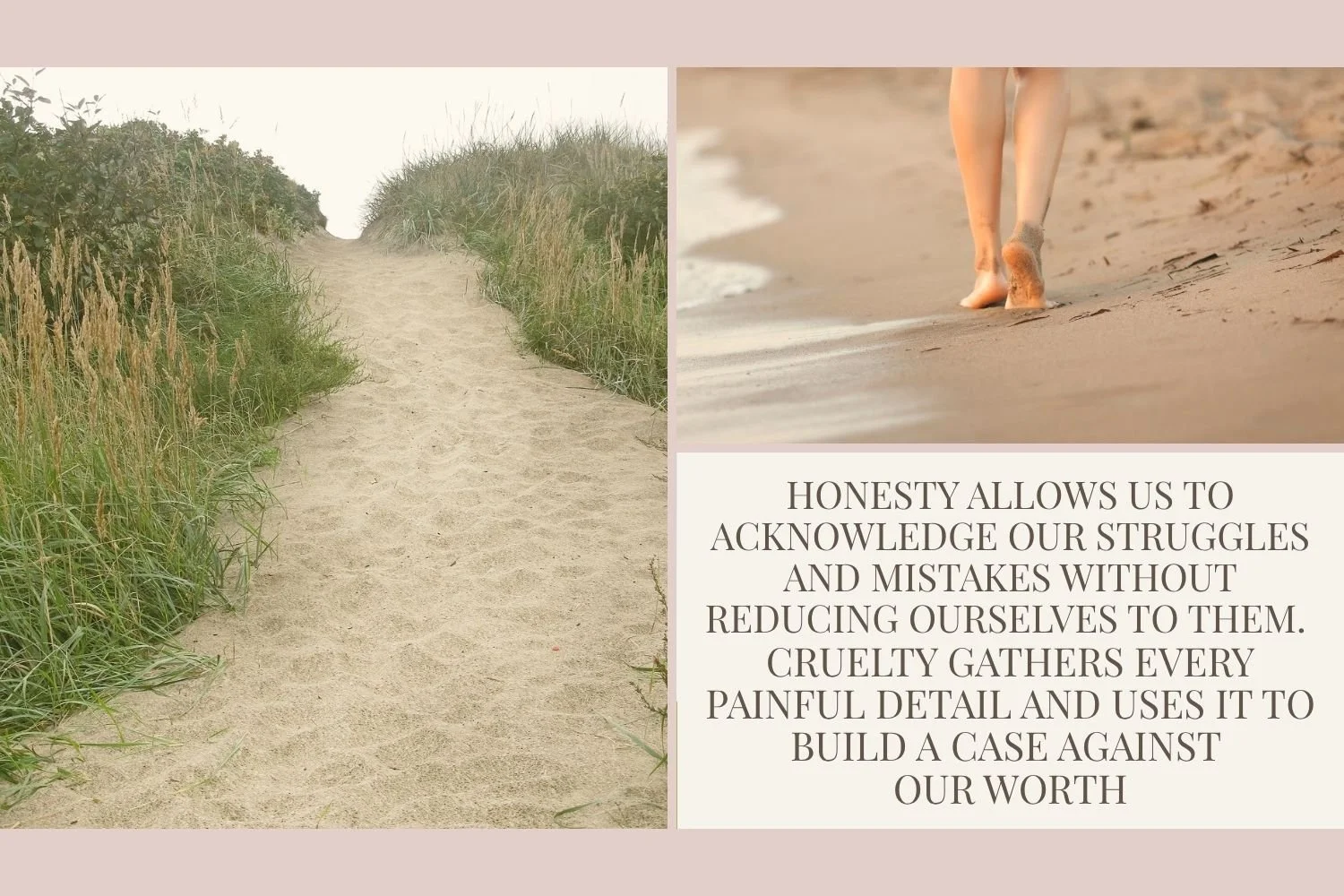
Honesty allows us to acknowledge our struggles and mistakes without reducing ourselves to them. Cruelty gathers every painful detail and uses it to build a case against our worth.
Learning how to stop negative self-talk does not mean pretending everything is fine. We don’t deny our mistakes, avoid taking responsibility, or cover the pain we feel with shallow optimism.
It means beginning to question a distorted version of ourselves we may have carried for years. While learning to see what pain, shame, and comparison left out.
And it means learning to tell ourselves the whole truth.
In This Post, You’ll Learn
If your inner voice becomes harsh when you make a mistake, feel rejected, compare yourself with someone else, or struggle through a difficult season…this post will help you understand what may be happening beneath those thoughts.
We will explore:
What negative self-talk is and why it can feel so believable
How painful experiences can shape the way you speak to yourself
Why shame and self-criticism rarely produce healthy, lasting change
How to separate what happened from what you made it mean about you
Seven compassionate ways to respond to your inner critic
How to replace harsh thoughts with truths you can genuinely believe
You do not have to deny your struggles or cover them with forced positivity. You can learn to see yourself honestly without using that honesty against yourself.
A thought can feel true without representing the whole truth.
What Is Negative Self-Talk?
Negative self-talk is the critical, discouraging, or demeaning commentary that runs through our mind and spews out of our mouth.
Sometimes it is loud and unmistakable:
“I’m a failure.”
“No one really wants me around.”
“I ruin everything.”
“I’ll never change.”
“I’m not as capable as everyone else.”
“There must be something wrong with me.”
Other times, it is more subtle:
“I should be further along.”
“Other women handle life better than I do.”
“I shouldn’t still feel this way.”
“I need to get myself together.”
“Why can’t I just be normal?”
These thoughts may feel factual because they often contain a fragment of truth.
Perhaps you did make a mistake.
Perhaps someone did reject you.
Perhaps you are struggling.
Or, maybe you reacted in a way you regret.
But a fragment of truth is not the whole truth.
That is what makes negative self-talk so convincing. It does not always begin with a complete lie. Often, it begins with something painful or imperfect and stretches it into a conclusion about your entire identity.
“I am struggling” becomes “I am incapable.”
“I made a mistake” becomes “I’m stupid.”
“I was rejected” becomes “I am unlovable.”
“I am still healing” becomes “I will never change.”
A negative thought takes one moment, one weakness, or one painful experience and uses it to define the whole person.
This is one way we lose sight of our true identity. We begin to confuse what happened to us, what we feel, or what we regret with who we are.
Why Are We So Hard on Ourselves?
Your critical inner voice did not appear out of nowhere.
For many of us, negative self-talk developed gradually. It may have been shaped by criticism, comparison, painful relationships, bullying, emotional neglect, abuse, rejection, unrealistic expectations, or repeated experiences of feeling unseen or not good enough.
Sometimes we internalize the way other people spoke to us. Or we criticize ourselves first because we believe it will hurt less than being criticized by someone else.
Sometimes self-criticism becomes an attempt to stay safe:
“If I can identify everything wrong with me, perhaps I can fix it before anyone notices or rejects me.”
“If I expect the worst from myself, then I won’t be disappointed again.”
“I don’t want to embarrass myself again, so I won’t try because it hurt last time.”
“If I keep beating myself up over what I did, maybe that proves that I really am sorry and understand how wrong it was.”
For me, constantly watching for what was wrong with me did not make me feel safe. It kept me braced. And, honestly, it was exhausting. I would be hesitant to speak, afraid to try, and quick to retreat when I thought I had done something wrong. At this point in my life, I was not being guided by a wise inner voice. I was being governed by fear.
A Mary Moment: When “Less Than” Started Early

When I think back to some of my earliest memories, I remember already feeling inferior.
I can’t point to one particular moment when that belief began. There wasn’t a single event I can identify and say, That’s when I decided I wasn’t enough. It seems to have formed quietly, over time, through a collection of experiences and things that were missing.
My parents cared for us. My dad owned his own business, and we had a nice home, clothes to wear, and plenty of food. Our physical needs were met. But when I look back, I don’t remember much nurturing, praise, affection, or the kinds of words that tell a child, I see you. I delight in you. There is something wonderful about who you are.
Maybe some of those things were said. I don’t remember them.
My siblings have expressed similar feelings over the years. We have talked more than once about how, although we were taken care of, we never really felt deeply wanted. The difference between being provided for and feeling treasured is huge.
As a little girl, I had no language for any of this. I just noticed what I saw.
One of my neighborhood friends seemed to come from a happy family. They laughed together. She seemed to get along with her siblings. She was smart, confident, and capable. I remember looking at her life and then looking at mine, and without realizing it, comparison was already beginning to teach me something about myself. She seemed to have something I didn’t.
School reinforced the message.
Some of my earliest school memories are of being placed in the lower-level groups for core subjects. I struggled academically and often needed extra help. I guess summer school was intended to help you catch up and feel good about yourself. I just felt “less than.”
And when you’re a child, you don’t exactly get to struggle privately.
The other kids know who leaves the classroom for extra help. They know who is in the lower group. They know who gets the poor grades. Even when nobody says anything cruel, you are painfully aware that you are different than most others.
Then, I would bring my bad grades home and feel my parents’ disappointment.
Looking back now, I can see how easily a little girl could take all of those experiences and turn them into a conclusion about herself:
Other people are smarter than me.
Other families are happier than mine.
Other children have something I don’t.
I disappoint people.
There must be something lacking in me.
No one told me I was inferior. I was quietly building that belief myself from the evidence I thought I saw.
Of course, what I couldn’t understand then was that struggling in school was not an accurate measurement of my worth. My parents’ limitations in expressing affection did not mean I was unlovable. Another child’s confidence did not diminish anything in me. And needing more encouragement than I received did not mean there was something wrong with needing it.
But children rarely make those distinctions. We experience something, feel something, and then we begin creating meaning around it.
For me, that meaning was: I am less than.
And once that belief took root, it gave me a lens through which I would interpret many experiences that came afterward.
It took years for me to realize that the little girl who thought she was collecting proof of her inadequacy was never actually discovering the truth about herself.
She was trying to make sense of her world with the limited information she had.
And when I began to understand that, something shifted for me. I could see that the critical voice I had carried for so many years had not appeared out of nowhere. In its own distorted way, it may have been trying to protect me, to keep me from failing, being rejected, looking foolish, or feeling the sting of not measuring up again.
But understanding where a pattern came from does not mean we have to keep living under its influence. Even if self-criticism began as a survival strategy, that does not mean it’s still serving us well. What may once have felt protective can eventually become another source of pain.
Harshness does not heal what harshness helped create.
You cannot shame yourself into feeling whole.
You cannot insult yourself into confidence.
You cannot continually treat yourself as an enemy and expect to feel safe within.
Understanding the wounds beneath these patterns can be an important part of healing the heart. It helps us move beyond asking, “What is wrong with me?” and begin asking, “What happened, what did I come to believe, and what do I need now?”
And that brings us to something especially important: if shame and self-criticism cannot heal us, why do we often believe they will somehow make us better?

Why Shaming Yourself Does Not Create Lasting Change
Many of us fear that without self-criticism, we will stop growing. We assume kindness will let us “off the hook.”
But self-compassion is not the same as self-excusing.
Self-compassion allows us to acknowledge what happened, accept responsibility where needed, and choose a healthier response, without turning one behavior into a condemnation of our entire identity.
Researcher Kristin Neff describes self-compassion through three central elements: self-kindness, common humanity, and mindfulness. In everyday language, this means responding to yourself with care, remembering that struggle is part of being human, and noticing painful thoughts and feelings without becoming completely consumed by them.
Her research review also addresses a common fear: self-compassion does not require us to become weak, selfish, indulgent, or unmotivated. It offers another way to respond to suffering and personal shortcomings. One that can support change without depending on shame.
Harshness is not the only path to accountability.
You can say:
“I should not have handled that situation the way I did.”
without saying:
“I am a terrible person.”
You can say:
“I need to make this right.”
without saying:
“I ruin everything.”
You can admit:
“I am struggling right now.”
without turning the struggle into your identity.
The goal is not to deny the truth. The goal is to stop adding cruelty to it.
How to Stop Negative Self-Talk Without Shaming Yourself
Changing the way you speak to yourself is rarely a one-time decision. It is a practice of noticing, questioning, and gently replacing an old pattern.
You are not trying to silence every negative thought forever. You are learning not to automatically believe it, obey it, or build your identity around it.
1. Notice the Thought Without Attacking Yourself for Having It
The first step is awareness.
You cannot change a pattern you do not notice.
When you feel a sudden drop in your mood, a wave of shame, or an urge to withdraw, pause and ask:
What did I just say to myself?
Try to identify the actual words.
Perhaps it was:
“I sounded so stupid.”
“I always make things awkward.”
“She is so much better than I am.”
“I should have accomplished more by now.”
“I will never get this right.”
Neff’s exercise for changing critical self-talk begins with noticing the critical voice and identifying its words as accurately as possible.
Then resist the urge to criticize yourself for being critical.
You may be tempted to think:
“There I go again. Why can’t I stop doing this?”
But that creates another layer of negative self-talk.
Instead, try:
“I’m noticing that I’m being very hard on myself.”
That small change matters.
It moves you from being trapped inside the thought to observing it. You are no longer declaring, “This is who I am.” You are recognizing, “This is what my mind is telling me right now.”
A thought is something you are experiencing.
It is not automatically a fact or definition of you.

2. Separate What Happened From What You Made It Mean
Negative self-talk often combines an event with a painful interpretation.
For example:
What happened: I forgot an appointment.
What I made it mean: I am irresponsible and cannot be trusted.
Or:
What happened: Someone did not respond to my message.
What I made it mean: I am annoying, and people do not want me around.
Or:
What happened: I became emotional during a difficult conversation.
What I made it mean: I am weak and incapable of handling life.
The event may be real.
The conclusion may not be.
Ask yourself:
What actually happened?
What am I assuming this says about me?
Am I turning one moment into a permanent identity?
Is there another honest explanation?
What information am I leaving out?
Examining your interpretation does not require you to invent a cheerful explanation. It simply asks you to become more accurate.
Instead of:
“I forgot the appointment because I am hopeless.”
Try:
“I forgot something important. I have had a lot on my mind, and I need a better reminder system.”
The second statement still acknowledges the problem. It simply leaves your dignity intact.
That is the difference between correction and condemnation.
3. Look for the Partial Truth
I have learned that many of my spirals thrived on partial truths.
That realization was important for me because my thoughts were not always built on something completely false. Often, something real had happened, but my mind stretched it, exaggerated it, and turned it against me.
A partial truth might say:
“I’m struggling.”
There is nothing wrong with acknowledging that.
But if I stop there and allow an old pattern of thinking to complete the story, I may begin to feel behind, unworthy, incapable, or foolish, as though the struggle is who I am.
The fuller truth might be:
“I am struggling, but struggling is not the sum total of who I am. I am also learning. I am showing up. I have survived difficult things before. I can ask for help. I can take one small step.”
The fuller truth does not erase pain.
It places the pain inside a larger, more honest picture.
A Mary Moment: When I Mistook Struggle for Truth
For me, there were several partial-truth spirals.
I spent much of my young adult life simply trying to keep my head above water. I drank too much to numb what I was feeling, and I had very little sense of direction. I wasn’t building toward anything. I was mostly wandering, longing for some kind of purpose or something that would make me feel as though my life mattered.
I tried college, but I struggled to commit to the work required to succeed. When I eventually dropped out, it seemed to confirm something I had already believed about myself for years. Because of my learning difficulties and the struggles I had experienced in school, I still carried the belief that I was stupid and incapable.
That was one of my deepest partial-truth spirals:
I struggled academically → therefore, I must not be very smart → if I’m not smart, I’ll probably never accomplish anything meaningful → if I never accomplish anything meaningful, then maybe I’m not worth very much.
The struggle was real. The conclusion I drew from it was not.
But at the time, I didn’t know the difference.
I desperately wanted to better myself. I wanted to discover something I was good at, something worthwhile that I could do with my life. But when that answer didn’t seem to come, I became more discouraged. I watched people my age finish school, begin careers, and step into what looked like real adult lives while I was still trying to find something—anything—that would make me feel capable and worthy.
Eventually, another spiral grew out of the first:
If I’m never going to amount to anything anyway, why does it matter what I do with my life?
And that belief permitted me to live without boundaries. I partied. I drank. I tried to escape the painful thoughts I had about myself. Those choices brought consequences of their own, which then became more evidence I could use against myself.
See? You really are a mess.
You really are immature.
Everyone else is moving forward, and you’re going nowhere.
And so the spiral kept feeding itself.
What I could not see then was that I had taken some very real struggles—learning difficulties, disappointment, uncertainty, and a lack of direction—and turned them into sweeping conclusions about my intelligence, my future, and ultimately my worth.
There were pieces of truth in the story I was telling myself.
But they were only pieces.
And I had mistaken them for the whole truth.
When you notice a harsh thought, ask:
What part of this is true, and what has been exaggerated, assumed, or turned against me?
Then ask:
What is the whole truth?
Perhaps the whole truth is:
“I did make a mistake, but one mistake does not make me a failure.”
“I am disappointed, but disappointment does not determine my worth.”
“I am not where I want to be, but I am not where I once was.”
“I have areas that need healing, but I am not broken beyond repair.”
“I feel insecure today, but this feeling is not a final verdict about me.”
Learning to tell the fuller truth is part of restoring worth and confidence. Confidence does not require us to pretend we never struggle. It grows as we stop using every struggle as proof against our value.

4. Speak to Yourself as You Would Speak to Someone You Love
One of the clearest ways to recognize unhealthy self-talk is to ask:
Would I say these same words to someone I love?
Imagine that a dear friend came to you after making a mistake. She is embarrassed, frightened, and disappointed in herself.
Would you say:
“You are such an idiot. You always ruin everything. No wonder people are disappointed in you”?
No, you would not!
You would probably help her see the situation honestly. You might encourage her to apologize, learn, establish a boundary, try again, or seek support. But you would not try to destroy her while correcting her.
Why, then, do we believe destruction is necessary when speaking to ourselves?
I began practicing this by using my own name:
“Mary, that was painful.”
“Mary, you wish you had handled that differently.”
“Mary, you are overwhelmed right now. Let’s slow down.”
“Mary, you are allowed to learn.”
“Mary, this moment does not erase your worth.”
At first, this kind of response can feel awkward or unnatural.
A Mary Moment: I remember fumbling my way through self-compassion.
What a gift it was to discover that self-compassion existed at all. My self-worth was so low that I could hardly believe changing the harsh way I spoke to myself could make any real difference. I was convinced that my particular type of “brokenness” was somehow worse than everyone else’s. I felt others had been given some basic sense of worth that I had somehow missed.
Discovering that this wasn’t true, that there was language for what I was experiencing, and that there was a gentler way forward, was no small thing for me. It was the beginning of seeing myself differently. Self-compassion helped me stay present with my pain long enough to face it without collapsing beneath it.
At first, though, kindness toward myself felt fake. I would repeat compassion statements or sit with my journal and try to say something gentle, and the words felt as though they belonged to someone else. I wanted these things to be true, and I wanted to stop treating myself so badly, but I had practiced criticism for so long that compassion felt foreign.
And strangely, my inner critic sometimes became louder when I began challenging it. At first, I took that as proof that self-compassion wasn’t working. Now I see it differently. The old voice had been in charge for so long that, of course, it resisted being replaced.
Progress was uneven. I could experience a genuine moment of tenderness toward myself and then fall back into harsh self-talk an hour later. Eventually, I began to understand that change happens over time. It comes in waves: old patterns return, new ones grow stronger, and little by little, a different way of relating to myself takes root.
Perhaps the most unexpected part was the grief. Learning to be kind to myself also meant realizing how long I had lived without that kindness. Self-compassion opened the door to relief and my eventual healing, but I also felt sorrow because I had spent so many years believing I deserved my own harshness.

5. Replace the Harsh Thought With a Believable Truth
When people hear “replace negative thoughts,” they sometimes imagine forcing themselves to repeat statements they do not believe:
“I am amazing.”
“I love everything about myself.”
“Everything is wonderful.”
When you are hurting, statements like these may feel hollow or even irritating.
A compassionate replacement does not have to be dramatic. It needs to be truthful, balanced, and believable.
Instead of:
“I am a complete failure.”
Try:
“This did not go the way I hoped, but one outcome cannot define my whole life.”
Instead of:
“I hate how emotional I am.”
Try:
“My emotions are telling me that something matters or needs attention. I can listen without allowing them to make every decision.”
Instead of:
“I should be over this by now.”
Try:
“Healing does not follow the timetable I once expected. I can honor the progress I have made while continuing to move forward.”
Instead of:
“I am so far behind everyone else.”
Try:
“I am comparing my private struggles with what I can see of someone else’s life. My path does not have to look like hers to have value.”
Instead of:
“No one could love someone as broken as me.”
Try:
“I have been hurt, but hurt is not the same as being broken or unlovable. I am still worthy of patience, connection, and care.”
6. Ask What the Critic Is Trying to Protect
Sometimes fighting the critical voice makes it louder.
Instead, become curious.
Ask:
What is this part of me afraid will happen?
What is it trying to prevent?
When did I first learn to speak to myself this way?
Does this voice sound like anyone from my past?
What does this frightened or overwhelmed part of me need?
You may discover that beneath:
“You need to do this perfectly”
is the fear:
“If you fail, people will reject you.”
Beneath:
“Do not let anyone see how you feel”
may be:
“It was not safe to be vulnerable before.”
Beneath:
“You should have known better”
may be:
“I am terrified of making another painful mistake.”
Understanding the fear beneath the criticism does not mean allowing that voice to continue mistreating you. It means responding to the source of the pain rather than arguing only with the surface thought.
Sometimes the parts of ourselves we criticize most are the parts that are tired, afraid, wounded, or overwhelmed.
Criticism adds more weight.
Compassion asks:
“What is needed here?”
7. Choose One Small, Loving Next Step
Healing can feel overwhelming when you believe you must change every thought, repair every wound, and become completely confident all at once.
But renewal often begins with one small next step.
One kinder thought.
One honest conversation.
One boundary.
One moment of rest.
One request for help.
One decision not to replay a mistake for the fiftieth time.
One choice that says:
“I am worth caring for, even while I am still growing.”
Ask yourself:
What is the next loving and responsible thing I can do?
The answer might be to apologize.
It might be to rest before responding.
It might be to write down the whole truth.
It might be to seek support from a qualified professional.
It might be to step away from a relationship or conversation that repeatedly reinforces shame.
It might simply be to place your hand over your heart and say:
“This is a hard moment. I do not have to turn against myself because I am hurting.”
Kristin Neff writes: “Self-compassion is a practice of goodwill, not good feelings.”
In other words, self-compassion is not a demand that pain immediately disappear. It is a supportive way of responding to yourself while the pain is present.
Choosing one loving next step is also part of living renewed. Renewal does not require one giant transformation. It is often built through small, truthful decisions repeated over time.
What to Do When the Negative Voice Returns
Sadly, yes, it will return.
That does not mean you failed.
Old thought patterns are well-practiced. They often become louder when we are tired, embarrassed, rejected, stressed, grieving, or facing something unfamiliar.
Progress is not measured by never having another negative thought.
Progress may look like:
Recognizing the thought sooner
Believing it less completely
Recovering more quickly
Choosing not to repeat it all day
Responding with curiosity instead of contempt
Asking for support instead of isolating
Remembering that a difficult moment is not your whole identity
You may still hear:
“You are not enough.”
But now another voice can answer:
“I am having a painful moment, but my worth has not disappeared.”
You may still hear:
“You always mess things up.”
But truth can answer:
“I have made mistakes, and I have also learned, repaired, endured, loved, tried again, and grown.”
You may still hear:
“You should be further along.”
But compassion can answer:
“I am allowed to be a person in process.”
That is how change begins, not by shaming the critical voice into silence, but by strengthening a truer, more compassionate voice alongside it.

You Are More Than the Harshest Thing You Have Ever Believed About Yourself
There may be reasons you learned to speak to yourself this way.
There may be wounds behind the words, or relationship failures, betrayals, or painful experiences that have shaped how you came to see yourself.
But what happened to you is not the same as who you are.
What you regret is not the whole of you.
What someone said about you is not the final authority on your worth.
The season in which you struggled most does not get to name you forever.
You do not have to deny your imperfections to treat yourself with dignity. You do not have to pretend you have healed completely to recognize that you are healing. You do not have to become someone else before you are worthy of kindness.
Your inner voice may have been harsh for a very long time.
But it can learn a new language.
A language that tells the truth without cruelty.
A language that makes room for accountability without condemnation.
A language that recognizes pain without turning pain into identity.
A language of patience, honesty, compassion, and hope.
And perhaps today, the first sentence in that new language is simply this:
I will not use this difficult moment as another reason to abandon myself.
Take the Next Step Toward a More Compassionate Inner Voice
Changing negative self-talk begins by slowing down long enough to recognize what you have been saying to yourself, and then learning to answer with the whole truth.
My free guide, 5 Truth-Based Prompts to Help You See Yourself with More Compassion, was created for the woman who is tired of being so hard on herself.
The prompts will help you examine the words you have been carrying, separate truth from shame, and identify one loving next step toward healing.
Sources and Further Reading
The ideas in this article are informed by research and educational resources on self-compassion, self-criticism, mindfulness, and the process of examining distressing thoughts more accurately.
American Psychological Association. “5 Steps of Cognitive Restructuring.” An educational resource describing a process for carefully examining thoughts that arise during upsetting or distressing experiences.
Neff, Kristin D. “Changing Your Critical Self-Talk.” Self-Compassion.org. An exercise for noticing the self-critical voice, softening its language, and reframing its observations more compassionately.
Neff, Kristin D. “What Is Self-Compassion?” Self-Compassion.org. An introduction to the central elements of self-compassion: self-kindness, common humanity, and mindfulness.
Neff, Kristin D. “Self-Compassion Practices.” Self-Compassion.org. Guidance for approaching self-compassion as a practice of goodwill and support rather than a method for suppressing difficult emotions.
Neff, Kristin D. “Self-Compassion: Theory, Method, Research, and Intervention.” Annual Review of Psychology, vol. 74, 2023, pp. 193–218.
Wakelin, Katherine E., et al. “Effectiveness of Self-Compassion-Related Interventions for Reducing Self-Criticism: A Systematic Review and Meta-Analysis.” Clinical Psychology & Psychotherapy, 2022.
Important note: This article is intended for education and encouragement and is not a substitute for individualized mental health care. If negative thoughts are persistent, overwhelming, or connected to thoughts of harming yourself, please seek support from a qualified professional or an appropriate crisis service.